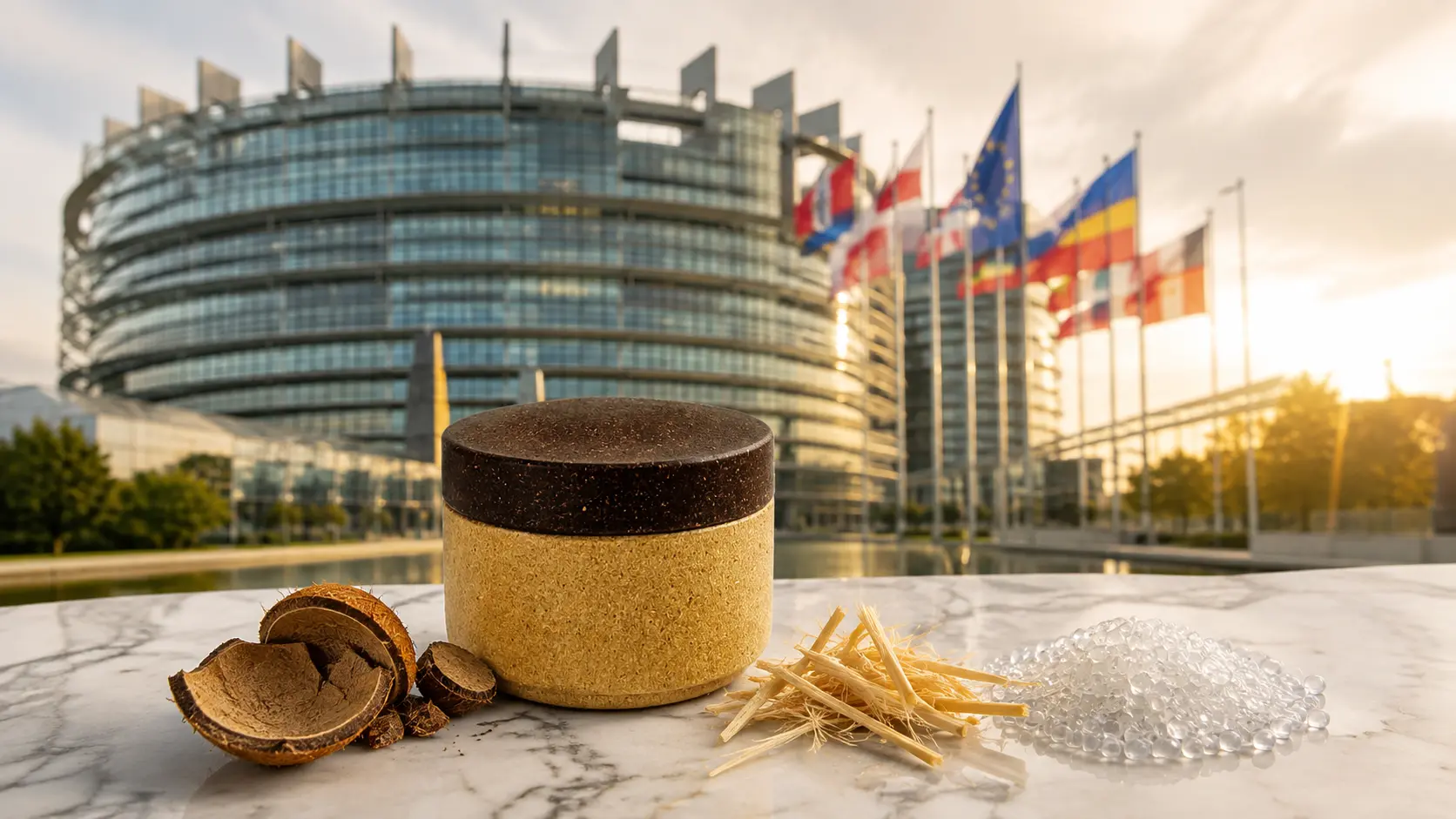
What the PPWR is
The EU Packaging and Packaging Waste Regulation — formally Regulation (EU) 2025/40, commonly referred to as the PPWR — replaced the 1994 Packaging and Packaging Waste Directive that had governed EU packaging law for over three decades. The regulation applied directly across all EU member states from August 12, 2026, without requiring national transposition. This means the requirements are the same in France, Germany, the Netherlands, Poland, and every other member state simultaneously.
The PPWR covers all packaging placed on the EU market — including packaging on goods imported into the EU from outside member states. A cosmetic brand in the UK, India, the UAE, or Singapore that sells product into Germany or France is subject to the PPWR for the packaging on those products. The regulation's reach is determined by where the product is placed on the market, not where the packaging is manufactured.
The regulation consolidates several requirements that previously existed in fragmented form across national laws: recyclability standards, recycled content targets, Extended Producer Responsibility, packaging minimisation, and labelling. Each of these is now being harmonised into a single EU-wide framework.
The recyclability mandate
The PPWR's most consequential provision for cosmetic brands is the recyclability mandate: all packaging placed on the EU market must be recyclable by 2030. Recyclability is defined at design level, not in theoretical terms. Packaging must be designed so it can be collected, sorted, and recycled in practice — across actual EU waste management infrastructure — not merely in a laboratory setting.
This is a harder standard than it first appears. Packaging that is technically recyclable but relies on collection or sorting infrastructure that does not exist at scale in the EU does not meet the standard. Packaging with mixed materials that cannot be separated at sorting facilities does not meet the standard. The recyclability assessment must account for real-world end-of-life pathways, not ideal conditions.
For cosmetic packaging specifically, the challenge is that many formats in current use — multi-material pumps, foil-laminated pouches, and jar designs with mixed polymer components — do not meet the 2030 recyclability standard as currently designed. Brands that have not yet mapped their packaging portfolio against the PPWR recyclability criteria are doing that work now, or will need to.
Phase-in timelines for the recyclability mandate vary by packaging category. The 2030 deadline applies broadly; specific formats have staggered compliance dates within that window. Your packaging advisor or EPR compliance provider maps the applicable timeline to your specific product range.
Recycled content targets for plastic packaging
Alongside recyclability, the PPWR sets mandatory minimum recycled content targets for plastic packaging. These are targets for the recycled content in new packaging — not a tax on packaging below the threshold (as the UK PPT is), but a mandatory requirement that packaging placed on the EU market must contain a minimum proportion of recycled material.
The targets are set by packaging category and material type, with phase-in dates running from 2030. Rigid plastic packaging for cosmetics and personal care falls within the categories covered. The specific percentage targets and timelines for each category are determined by the European Commission's implementing acts — brands and their suppliers are required to document recycled content and provide evidence to importers, distributors, and EPR scheme administrators on request.
Post-consumer recycled plastic at the quality required for cosmetic-grade rigid packaging — food-contact equivalents or better, consistent colour, no odour migration — is in constrained supply. The economics of meeting mandatory targets are different from the economics of voluntary sustainability claims. Brands that have not yet secured supply of qualifying post-consumer recycled material are facing a procurement challenge that will sharpen as 2030 approaches and demand across all packaging sectors increases simultaneously.
Extended Producer Responsibility harmonisation
EPR for packaging has existed in most EU member states for years, but the fee structures, material categories, and reporting requirements have differed significantly between countries. A brand selling into Germany, France, and the Netherlands has previously been required to register with and report to three different national EPR schemes, each with different rules.
The PPWR harmonises EPR across the EU. Fees remain eco-modulated — higher for packaging with worse environmental performance, lower for packaging with better recyclability or recycled content — but the assessment framework becomes consistent across member states. This reduces administrative complexity for brands operating across multiple EU markets and creates clearer incentives for material decisions that perform well on environmental criteria.
Bio-composite packaging, which contains no fossil plastic, sits in a different EPR material classification band to standard plastic. The eco-modulation applied to bio-composite is an assessment your EPR advisor completes using the material documentation — primarily a material composition declaration and a bio-based content certificate. The fee outcome depends on the specific scheme implementation in each member state, but the classification starting point is different to conventional plastic.
Where bio-based materials sit — and where they do not
It is worth being direct about what bio-based content does and does not address under the PPWR.
Bio-based content — the proportion of carbon in a material derived from biological rather than fossil sources — is measurable, certifiable, and recognised by the regulation as environmentally relevant. A 93% bio-based content certificate from TÜV SÜD (ASTM D6866, Frankfurt, May 2026) is internationally recognised documentation of the material's carbon origin. It supports EPR classification, product-level carbon footprint calculations, and brand sustainability claims that reference bio-based content specifically.
What bio-based content does not automatically address is the PPWR's recyclability mandate. Recyclability and bio-based content are independent properties. A material can be 100% bio-based and not recyclable in EU municipal streams. A material can be recyclable and entirely fossil-derived. The PPWR treats these as separate assessments, and rightly so — conflating them leads to compliance errors in both directions.
For bio-composite packaging made from coconut shell and bamboo fiber: recyclability in EU waste streams is not yet established as a formal certified claim. The material contains no fossil plastic, which changes the nature of the conversation compared to conventional packaging — but it does not automatically satisfy the 2030 recyclability requirement. This is a point of honest differentiation between the bio-based content position and the recyclability position.
The PPWR recognises that for certain packaging formats where recyclability is not yet technically achievable at scale, alternative approaches apply. Whether a specific packaging format qualifies for these provisions is an assessment your packaging and sustainability advisor makes based on the material's documented properties and the specific PPWR implementing acts for that category.
Labelling requirements
The PPWR introduces mandatory labelling requirements for packaging placed on the EU market. These include recyclability labelling — a standardised symbol indicating whether and how the packaging can be recycled — and material composition labelling. The recyclability label must reflect actual performance in EU waste systems, not theoretical recyclability.
For brands importing cosmetics into the EU, the labelling requirements apply to the packaging as placed on market. Getting the label right requires clarity on the material's actual recyclability status — a point that underlines why the recyclability assessment needs to precede label design, not follow it.
What this means for sourcing decisions made now
The PPWR applied in August 2026. The 2030 recyclability mandate is 42 months away. The recycled content targets begin phasing in from 2030. On that timeline, 42 months sounds sufficient. In practice, it is not.
A packaging switch — from initial material evaluation to commercial supply at volume — typically takes between twelve and twenty-four months. This covers formulation compatibility testing, regulatory documentation, supplier qualification, design adaptation for the new format, and lead times for initial production. For brands switching to a materially different packaging category (from plastic to bio-composite, for example), the qualification process is longer, not shorter, because there is less established compatibility data to draw on.
Brands that begin material evaluation in late 2026 have a realistic window to complete qualification and transition before the 2030 deadline, with time to resolve any compatibility issues that arise. Brands that begin in 2028 are operating with little margin for the unexpected, and they will be competing with many others attempting the same move simultaneously — with predictable pressure on supplier capacity and documentation timelines.
The decision that needs to be made now is not which packaging to buy — it is which material to evaluate. An evaluation kit puts the physical material in the hands of the packaging, formulation, and sustainability teams who need to assess it. Documentation follows evaluation, not the reverse.
For brands sourcing from outside the EU
The PPWR applies to packaging placed on the EU market, regardless of where it is manufactured. A cosmetic brand sourcing packaging from India — or any non-EU country — is fully subject to the regulation for products sold into EU member states. The importer of record carries the primary compliance obligation in most member states, though this varies by implementation.
Sourcing from outside the EU is not a compliance risk in itself, provided the packaging meets PPWR requirements and the documentation is in order. What changes is the documentation burden: the importer needs to be able to demonstrate material composition, recycled content, recyclability assessment, and EPR registration to national authorities on request. A supplier that cannot provide third-party verified documentation makes that burden significantly harder to discharge.
Agropak supplies TÜV SÜD bio-based content certification, CIPET structural test reports, and a material composition declaration with every commercial order — the same documentation package included in evaluation kits shipped to EU brands.
Sourcing packaging for European distribution?
See how Agropak works with European cosmetic brands — PPWR documentation, Green Claims Directive positioning, and evaluation kits shipped via DHL to EU addresses.
Packaging for European brands →