Material comparison
Agropak bio-composite vs. molded fiber and bagasse cosmetic packaging.
Molded fiber — made from bagasse, recycled paper pulp, or agricultural residues — is widely used for dry product packaging. For cosmetic jars holding wet formulations, it has structural and porosity constraints that matter. This is the direct comparison.
The critical difference is the inner surface. Molded fiber is porous by nature. A cosmetic jar has to hold a cream, serum, or balm against direct contact for 2 or more years. That requires a non-porous inner surface. Agropak solves this with a cosmetic-grade barrier coating. Molded fiber formats typically require a separate liner insert — often plastic — to achieve the same result.— Agropak material development note
Subject of comparison
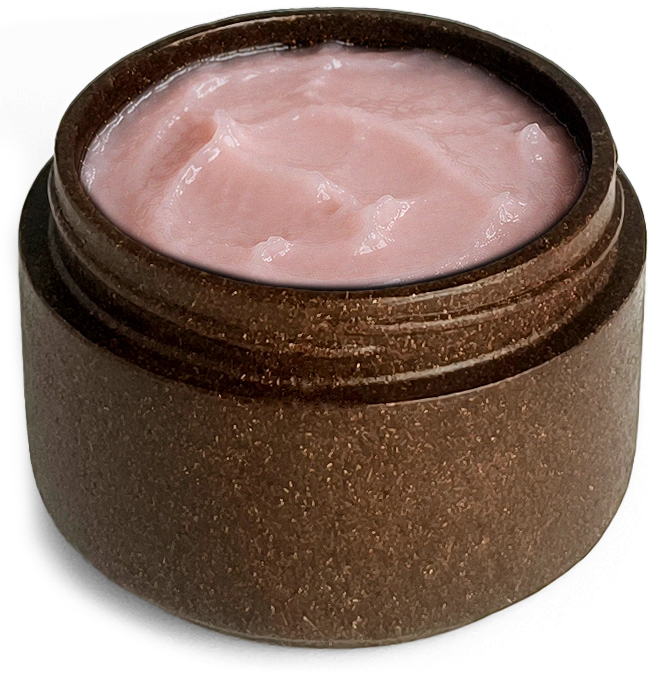
Agropak 50ml jar.
Bio-composite.
| Property | Agropak bio-composite | Molded fiber / Bagasse (pressed pulp, bagasse, or recycled fiber formats) |
|---|---|---|
| Inner surface for wet formulations | Cosmetic-grade barrier coating, transparent, applied to inner surfaceNo separate liner required. Internal compatibility study across common skincare formulation categories. | Porous by nature. Raw molded fiber cannot hold wet cosmetic formulations without a separate inner liner. Most molded fiber cosmetic jar formats require a plastic or wax liner insert — reintroducing the material the brand was switching away from. |
| Formulation contact safety | internal compatibility study across 6 cosmetic types. No fiber migration observed. Independent certification in progress.Results available for review on request. | Fiber migration risk without liner. Water-based formulations absorb into unlined fiber. High-water formulations may cause structural degradation over a 2-year shelf life. |
| Moisture resistance | Barrier coating applied. High-humidity shelf life assessment in progress. | Inherently moisture-absorbent. In high-humidity environments (common bathroom storage), unprotected molded fiber degrades structurally. Liner inserts mitigate but add material complexity. |
| Compression strength | 15,492 NAxial compression test. CIPET, Bengaluru — May 2026 | Varies significantly by formulation and fiber density. Molded fiber is generally less rigid than compression-molded bio-composite for the same wall thickness. No published independent compression data for most cosmetic jar formats. |
| Drop resistance | Passed 0.8m concrete drop testCIPET, Bengaluru — May 2026 | Molded fiber can crack or deform on impact, particularly in thinner-walled formats. Performance varies by fiber grade and density. |
| Bio-based content | 93% verifiedASTM D6866, TÜV SÜD verified May 2026 | High bio-based content (fiber is from biological origin), but typically without third-party radiocarbon verification using ASTM D6866 methodology |
| Surface finish quality | Consistent natural matte surface across the jar body. Fine grain texture. | Surface texture is coarser and less consistent than compression-molded material. Label adhesion and printing compatibility can be inconsistent between batches. |
| Thread / closure integrity | Screw-thread closure in the same bio-composite material. Consistent thread dimensions across production runs. | Thread precision is difficult to achieve in molded fiber. Most molded fiber cosmetic formats use a separate lid in a different material (often plastic or glass), making the system multi-material. |
| Independent test data | CIPET May 2026 (mechanical). TÜV SÜD verified May 2026 (bio-based). Internal formulation compatibility study. | Independent mechanical or formulation compatibility test data is rarely published by molded fiber cosmetic jar suppliers. Typically sold on material origin claims only. |
| Suitable for | Wet cosmetic formulations: face cream, body butter, balm, gel cream, sunscreen, night cream | Best suited to dry products: powder, solid formats, or products with protective inner packaging. Wet cosmetic formulations require liner insert. |
The right tool for the job
When to use molded fiber. When to use Agropak.
Molded fiber works well for outer packaging, mailers, and dry product formats — pressed powder, solid shampoo bars, soap. Where there is no direct formulation contact, the porosity problem disappears.
Face creams, body butters, balms, gel creams. The barrier coating means no liner insert is required. The internal compatibility study gives your formulation team data to work with before committing.
Many molded fiber cosmetic jar suppliers include a plastic liner insert to solve the porosity issue. This is a practical engineering choice, but a brand describing the result as plastic-free packaging needs to account for the liner in that claim.
Most molded fiber suppliers in the cosmetic packaging space do not publish third-party mechanical test data. Agropak has published independent third-party mechanical test results from CIPET, Bengaluru. Ask any supplier for the same level of documentation.
Also compare
Further reading
Evaluate the material
Evaluate a jar that holds wet formulations without a liner.
Evaluation samples typically dispatched within a few working days. Sample kits are ₹299 + shipping charges. No commercial commitment required.