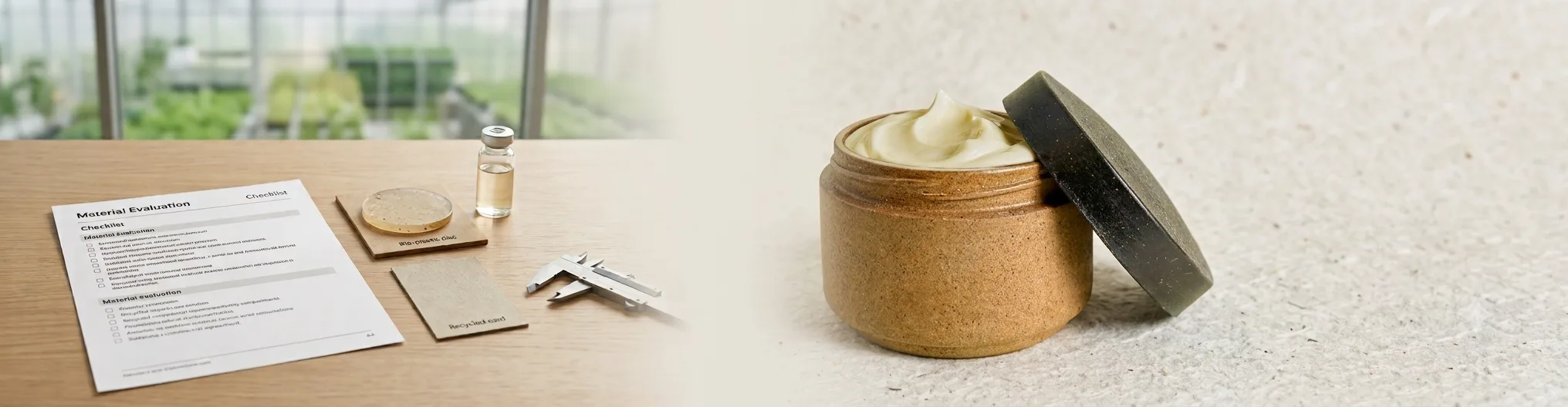
Switching packaging materials is a non-trivial decision. The cost of getting it wrong, after label design, SKU onboarding, and production runs, is high. The evaluation phase is worth taking seriously. This guide is a structured checklist for that phase, written from the perspective of what questions actually matter and in what order.
Step 1: Establish the functional requirements first
Before evaluating any specific material, write down what the packaging is actually required to do. This sounds obvious; it is frequently skipped. The requirements include:
- Formulation type and chemistry. pH, water content, oil content, presence of active ingredients. Some materials interact with specific formulation chemistries.
- Required shelf life. 12 months, 24 months, 36 months. What is the shelf life claim on the product? The packaging must support it.
- Physical requirements. Drop resistance for the expected supply chain. Stack weight if palletised. Temperature range for storage and shipping.
- Fill process. Hot fill, cold fill, vacuum fill. Some materials are not compatible with hot-fill processes.
- Closure type. Threaded lid, snap fit, pump. The closure system is part of the packaging evaluation, not separate from it.
- Visual requirements. Colour range, finish, labelling method (applied label, sleeve, direct print, emboss).
Write these down before talking to a supplier. It makes the conversation faster and prevents the supplier's enthusiasm from substituting for your own analysis.
Step 2: Ask for documentation, not claims
Any supplier can describe their material in positive terms. What distinguishes credible suppliers from others is the documentation behind those descriptions. Ask for:
- Test reports with report numbers. A test result without a traceable report reference is unverifiable. Ask for the actual report or a certificate with a reference number you can cite.
- Third-party vs. internal testing. Internal testing is done by the supplier's own team under their own conditions. Third-party testing is done by an independent accredited laboratory. Both have value; they are not equivalent. Ask which applies to each claim.
- Testing scope. A compressive strength test tells you one thing. It does not tell you about formulation compatibility, UV resistance, or shelf life. Ask what was tested and what was not.
- Assessments in progress. A credible supplier will tell you what they don't have data on yet. If every question returns a confident answer with no gaps, that is worth noting.
The most useful question to ask a packaging supplier is not "what can your material do?" It is "what don't you have data on yet?" The answer tells you more about their credibility than the first question does.
Step 3: Physical evaluation before formulation testing
Get a sample before you run formulation tests. This sounds self-evident but the step is often compressed. A physical sample lets you assess:
- Weight and feel. Does the material communicate what you want it to communicate at the brand positioning you are targeting?
- Surface finish consistency. How much variation exists between units? Is the variation acceptable for your quality standards?
- Closure function. Does the lid seat correctly? Does it open and close as expected under normal use?
- Label compatibility. Will your planned labelling method work on this surface? Curved surfaces, texture, and material porosity all affect adhesive label performance.
- Drop resistance (informal). Not a substitute for certified testing, but dropping a jar onto a hard floor from table height gives you a quick data point.
If the physical sample fails basic qualitative evaluation, there is no point running formulation compatibility tests. This order saves time.
Step 4: Formulation compatibility testing
This is the most time-consuming part of the evaluation and cannot be shortcut. Compatibility testing involves filling the jar with your actual formulation, storing it under defined conditions (temperature, humidity), and measuring the formulation and packaging for changes over time.
Parameters worth tracking:
- pH stability of the formulation
- Viscosity change
- Colour and odour change in the formulation
- Physical separation or precipitation
- Microbial counts (if preservative challenge is relevant)
- Visual changes to the packaging surface: staining, swelling, surface degradation
The timeframe depends on the shelf life claim. For a 24-month product, accelerated stability testing (typically 6 weeks at 40°C / 75% RH per ICH guidelines) is commonly used as a predictor of real-time stability, followed by real-time confirmation. Supplier-provided compatibility data for similar formulation types is useful preliminary evidence but does not substitute for your specific formulation under your testing protocol.
Step 5: Evaluate the supply chain, not just the material
A material that performs well in testing can still fail commercially if the supplier cannot deliver reliably at the quantities and lead times your business requires. Questions worth asking:
- What is the current production capacity? What is the lead time per order?
- What is the minimum order quantity for initial orders and for repeat orders?
- What quality control process applies to each production batch?
- What is the rejection and replacement policy if a batch fails your incoming inspection?
- What is the pricing structure at different volumes? Is there a published price list or is it inquiry-based?
For early-stage suppliers with new materials, capacity and lead time are often the constraint that limits commercial scale rather than the material itself. Understanding this early prevents it from becoming a surprise later.
What this looks like applied to Agropak
We include this section because we think it is useful to apply the framework to ourselves explicitly rather than leaving it as an exercise for the reader.
Documentation available: CIPET, Bengaluru (May 2026): compressive strength 15,492 N, 0.8 m drop test passed, third-party. TÜV SÜD, Frankfurt (May 2026): 93% bio-based content, third-party. Full report references are on the testing page.
Internal only: Formulation compatibility study across multiple cosmetic application types. This is internal data produced by Agropak's material research team. It is not third-party certified. Independent formulation compatibility certification is an assessment in progress.
Assessments in progress: Independent formulation compatibility certification, UV shelf life, humidity-controlled shelf life per EN standards.
Not tested: We have not pursued compostability or biodegradability certification. We do not claim these properties.
Samples: ₹299 + shipping. Dispatched within 2 working days. No commercial commitment required to get a jar in hand.
That is an honest representation of where Agropak sits against the framework above. Use it as a starting point for your own evaluation.