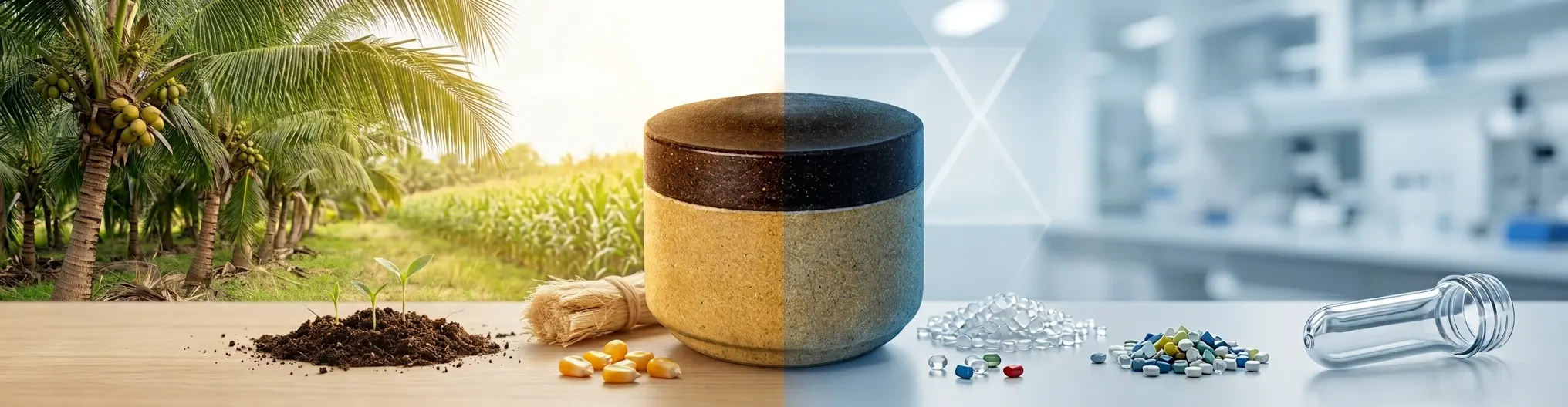
Starting position: what plastic does well
It is worth being direct: conventional plastic (HDPE, PP, ABS) is a well-engineered material for cosmetic packaging. It is lightweight, moisture-resistant, chemically inert across a wide range of formulations, available in any colour, and supported by decades of compatibility and shelf-life data. It is inexpensive to produce at scale. These are real advantages and any comparison that ignores them is not useful.
The primary reason brands consider alternatives is not that plastic performs poorly. It is that plastic's raw material is petroleum, which is a finite fossil resource, and end-of-life management in practice often results in landfill or incineration rather than meaningful recycling.
Mechanical strength
For a rigid cosmetic jar, the relevant mechanical tests are compressive strength (resistance to crushing), drop resistance, and surface hardness. These determine whether the jar survives supply chain handling and consumer use.
Agropak's bio-composite material tested at 15,492 N compressive strength in axial load testing at CIPET (CIPET Bengaluru, May 2026). It passed a 0.8 m concrete drop test at the same facility. By comparison, cosmetic jars in HDPE or PP typically range from 2,000 to 8,000 N for equivalent wall thickness, though this varies significantly by design and grade.
The Agropak figure is higher than typical plastic jar benchmarks, which reflects the compression-molding process and the natural density of coconut shell fiber. The bio-composite is also heavier than an equivalent plastic jar, which some brands treat as a premium quality signal and others treat as a shipping cost concern.
Formulation compatibility
This is where plastic has the most established advantage: decades of documented compatibility data across every major formulation type. For a bio-composite material, this data has to be built from scratch.
Agropak conducted an internal formulation compatibility study across multiple cosmetic application types. The study assessed parameters including colour, viscosity, odour, and fiber migration. No formulation degradation was observed across these parameters.
This is internal data. It was produced under controlled conditions by Agropak's material research team, not by an independent laboratory. An independent formulation compatibility certification assessment is currently in progress.
For a brand evaluating this honestly: the internal study is meaningful preliminary evidence, not the same as independent certification. If your regulatory or quality requirements demand independent testing before commercial supply, that assessment is ongoing.
Shelf life
Plastic packaging is inert and does not interact with formulations under normal storage conditions. Shelf life for plastic-packaged cosmetics is limited by the formulation, not the packaging material, across most product categories.
For bio-composite packaging, the question is whether the packaging introduces any degradation pathway: moisture absorption into the material, off-gassing, or surface interaction with the formulation. Agropak's internal trials demonstrated 2-year shelf stability across the tested formulations. Independent long-term shelf life testing under controlled humidity and UV conditions is an assessment in progress.
Bio-based content and sourcing
Conventional plastic packaging contains 0% bio-based content. All carbon in the material comes from petroleum feedstock.
Agropak's bio-composite tests at 93% bio-based content (ASTM D6866, TÜV SÜD (Frankfurt, May 2026)). The raw materials are coconut shell and bamboo fiber, both agricultural co-products or cultivated crops with established supply chains in India. Neither requires virgin forest land or competes with food crops.
Surface finish and colour
Plastic packaging can be produced in any colour, finish (gloss, matte, soft-touch), and surface texture with consistency across batch. Bio-composite material has natural colour variation between jars because the raw material is not uniform at the fibre level. This is perceived differently by different brands: some treat the natural variation as authenticity; others require consistency that bio-composite cannot currently guarantee.
Agropak offers three colourways — Noir Black, Mocha Brown, and Sandstone — arising naturally from the bio-composite material itself. No pigment or dye is added. Because the jar and lid are interchangeable across colourways, brands have nine distinct combinations from a single format. Bright whites and pastels are not achievable without materials that would reduce bio-based content.
End-of-life
Neither conventional plastic nor bio-composite cosmetic packaging has a clean end-of-life story in most markets. This deserves honest treatment.
Conventional plastic cosmetic jars can be recycled in streams that accept the specific grade, but contamination with formulation residue frequently prevents this in practice. Most cosmetic packaging ends in landfill or energy recovery.
Agropak's bio-composite material contains no fossil plastic. The disposal pathway depends on the barrier coating chemistry and local waste infrastructure. The company does not claim the material is compostable or biodegradable; those properties would require separate testing and certification that has not been pursued.
What this means for a brand evaluation
If you are switching from plastic because formulation compatibility data exists and is documented: it is partial for bio-composite materials at this stage. The internal study is real; independent certification is in progress.
If you are switching because you want to make a specific, auditable claim about bio-based content: 93% bio-based content with independent TÜV SÜD certification is a credible and defensible number.
If you are switching because of end-of-life: bio-composite is not a solved story. It is a different story (no fossil carbon in the material), not a complete one.
The most useful next step is to hold a jar, fill it with your formulation, and run your own evaluation. That is what the sample program is for.