The Southeast Asian beauty export opportunity — and the documentation barrier
Thailand, Indonesia, Vietnam, Malaysia, and the Philippines have developed cosmetic industries with genuine international appeal. Thai herbal formulations, Indonesian jamu traditions, Vietnamese botanical actives, and Malaysian natural ingredient sourcing are not marketing constructs — they reflect real formulation depth rooted in regional plant knowledge. The global beauty market has been receptive to these stories, and export growth from Southeast Asian brands into EU, UK, and East Asian markets has been measurable.
The barrier that appears consistently is documentation. International buyers — EU distributors, UK retail chains, Japanese department stores, Korean beauty importers — operate in regulated markets with formal procurement processes. When they ask for packaging documentation and receive a supplier declaration rather than a third-party certificate, or a material data sheet rather than a verifiable lab report, the qualification process stalls. This is not scepticism about the brand's authenticity. It is the documentation infrastructure required to sell into regulated markets.
The certification gap is not about the product quality or the brand story. It is about having packaging whose environmental credentials can be verified independently — the same way the formulation ingredients are verified for CPNP notification or INCI listing.
What EU buyers require from imported cosmetic packaging
EU buyers importing cosmetics from Southeast Asia work within a regulatory framework that has tightened significantly in 2025 and 2026. The EU Packaging and Packaging Waste Regulation (PPWR), which applied from August 12, 2026, requires packaging documentation from all products placed on the EU market — including imports from outside the EU.
The EU Green Claims Directive, currently being phased in, requires that any environmental claim made on packaging or in marketing — "natural," "sustainable," "bio-based," "eco-friendly," or similar — be substantiated by third-party evidence meeting defined methodological standards. A brand claim that packaging is bio-based must be supported by a certificate from an accredited independent laboratory using a recognised method. Self-declared percentages, brand-authored sustainability summaries, and supplier letters do not meet the standard.
For a Southeast Asian brand whose packaging sustainability story is central to its EU positioning, this means the certificate is not an optional enhancement — it is the prerequisite for making the claim. A brand that positions its product as "packaged in natural materials" in EU markets without a TÜV SÜD or equivalent certificate is making a claim it cannot substantiate under EU law.
What Japanese and Korean buyers require
Japan and South Korea are the two most documentation-intensive export markets in the Asia-Pacific region for cosmetics. Both markets have formal cosmetic product notification and import clearance processes that require extensive supplier documentation.
For packaging specifically, Japanese buyers typically require: a formal material composition declaration from the packaging manufacturer, structural performance data from an accredited testing institute, and — for any bio-based content claims — certification from an internationally recognised laboratory. TÜV SÜD, Bureau Veritas, and equivalent institutions are accepted; self-certification is not.
Korean buyers follow similar requirements, with additional scrutiny on claims related to environmental performance. The Korean Ministry of Environment's eco-label framework and the K-beauty export documentation processes both require that environmental packaging claims be formally certified, not brand-declared.
Southeast Asian brands that have attempted to qualify into Japanese or Korean retail channels through distributors will be familiar with the document request list that arrives at the start of the qualification process. Packaging is consistently on it. The brands that clear qualification fastest are those whose packaging supplier has already assembled the documentation.
The ingredient story and the packaging story
There is a particular commercial argument for Southeast Asian brands that is worth making explicitly. The natural ingredient heritage that drives their international appeal — rice ferment, turmeric, tamanu oil, ginger root, sea buckthorn — is grounded in authentic regional sourcing. The packaging, in most cases, is conventional plastic from a regional supplier with no particular story attached to it.
This creates a mismatch that sophisticated international buyers notice. A brand that uses wild-harvested botanical ingredients in a plastic jar is telling two different stories simultaneously — one about natural provenance, one about convenience of manufacture. For some brand positions, this is acceptable. For brands whose core positioning is around natural materials and ingredient transparency, it creates a gap that the packaging can close.
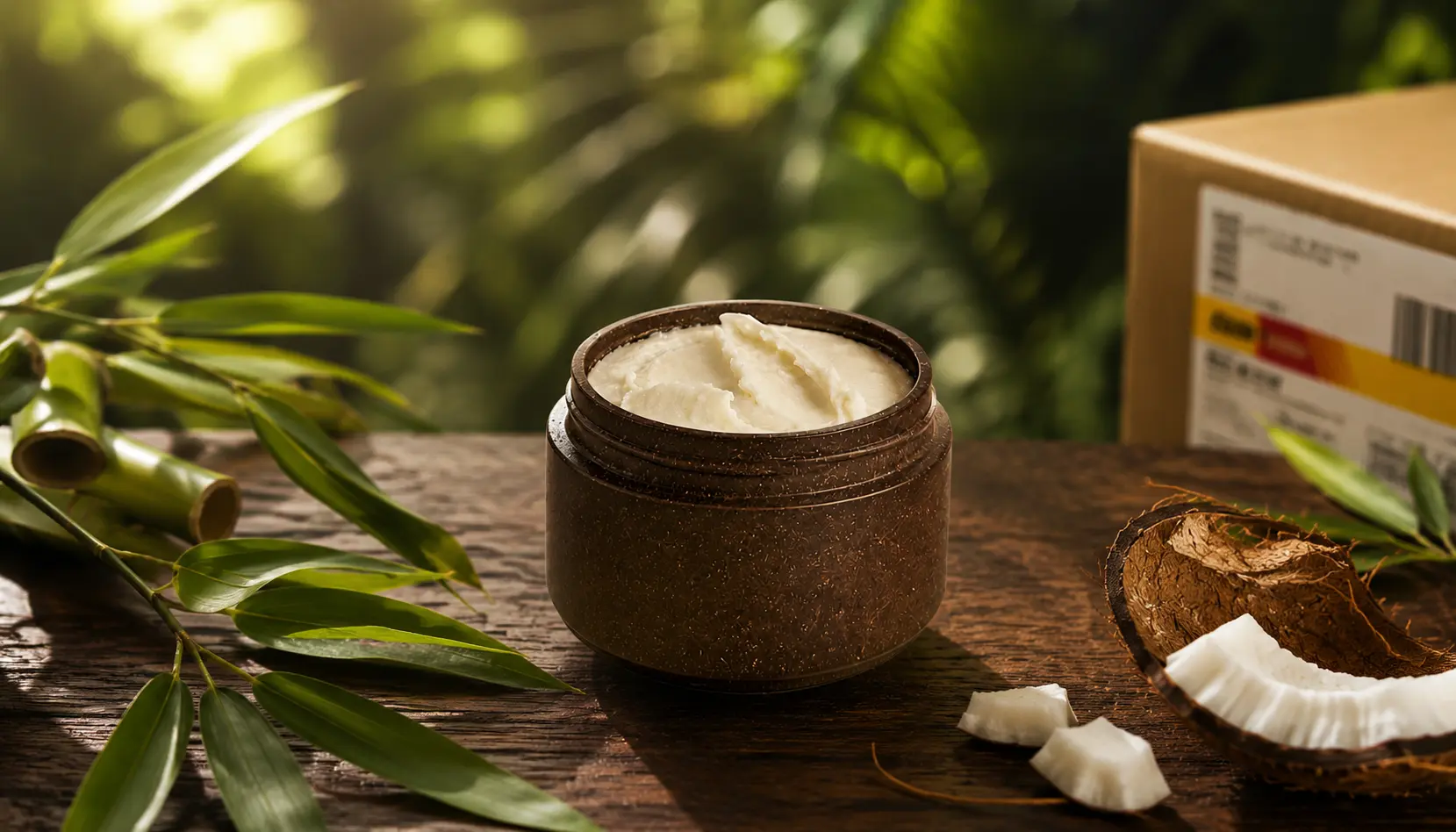
Bio-composite packaging made from coconut shell and bamboo fiber is a material from the same agricultural and natural tradition as the ingredients Southeast Asian brands typically feature. It is verifiable: 93% bio-based carbon content, certified by TÜV SÜD using ASTM D6866 isotopic analysis. It performs structurally: 15,492 N compression strength, 0.8 m drop test pass, 2-year shelf life validation, all from CIPET — a government-accredited testing institute. And it comes with the documentation that EU, UK, Japanese, and Korean buyers require.
Country-specific export contexts
The certification gap shows up differently across the region, shaped by each country's export infrastructure and target markets.
Vietnamese brands have been among the most active Southeast Asian cosmetic exporters to Europe, partly supported by the EU-Vietnam Free Trade Agreement (EVFTA) which reduces tariff barriers. The EVFTA covers tariff access; it does not reduce packaging documentation requirements. Vietnamese brands exporting to EU distributors under the EVFTA still face full PPWR and Green Claims compliance obligations for their packaging. Having a packaging supplier who can provide the required documentation has become a qualification differentiator.
Thai beauty brands have strong wellness and natural heritage positioning that translates well in the EU, UK, and Japan. The Thai FDA regulates packaging labelling domestically, but international export packaging requirements exceed Thai domestic standards in most areas. The documentation gap between Thai FDA compliance and EU or Japanese buyer requirements is where deals stall.
Indonesian brands targeting halal cosmetic markets in the Middle East and Southeast Asia face a combined requirement: halal certification for the formulation and increasingly ESG documentation for the packaging. Bio-composite packaging does not carry halal certification in itself — that is a formulation-level assessment — but the material declaration and bio-based certificate support the broader brand sustainability positioning that halal beauty export markets in the UAE and Malaysia are asking for.
Malaysian brands distributing through regional pharmacies and into Japanese and Korean channels face similar documentation pressure as their Thai and Vietnamese counterparts. The regional distribution networks in Malaysia — connecting to Singapore, Thailand, and beyond — increasingly require packaging documentation as part of their supplier qualification.
What closing the gap looks like in practice
The documentation required to satisfy EU Green Claims, PPWR, Japanese, and Korean buyer requirements comes from three sources: the packaging manufacturer, the testing laboratory, and the accreditation body.
Agropak provides all three as standard: the material composition declaration (from Agropak as manufacturer), the CIPET structural test reports (from a government-accredited testing institute in Bengaluru), and the TÜV SÜD bio-based content certificate (from an internationally recognised accreditation body using ASTM D6866). These documents are not produced on request for specific buyers — they exist and are included in every evaluation kit and commercial order.
Evaluation kits ship to Thailand, Indonesia, Vietnam, Malaysia, and the Philippines via DHL from Bengaluru. Shipping cost and timeline are confirmed before anything is charged. Each kit contains one jar per colourway — Noir Black, Mocha Brown, and Sandstone — with the full specification sheet and documentation package. The physical evaluation and the documentation review can proceed simultaneously, which compresses the qualification timeline.
For Southeast Asian brands that have been building their export ambitions but have been slowed by the packaging documentation question, the evaluation kit is the starting point. Hold the material. Fill it. Check the documentation. If it works, the certification gap closes.
Sourcing packaging for Southeast Asia?
See how Agropak works with brands based in Thailand, Indonesia, Vietnam, Malaysia, and the Philippines — third-party certification, EU and UK export documentation, and evaluation kits shipped via DHL.
Packaging for Southeast Asia brands →